
This article is written for educational purposes and paired with our editorial policy, nutrition review policy, and affiliate disclosure where relevant.
Supplements for ketosis may raise ketones in limited ways, but they do not reliably prove faster or sustained dietary ketosis. Product type and evidence quality matter more than marketing.
Health and safety notice: This article provides general education, not personal medical advice. In 24 healthy adults, consuming a ketone monoester three times daily for 28 days did not alter measured fasting electrolytes, blood gases, or kidney function. Mild nausea was reported after 6 of 2,016 ketone monoester drinks consumed in the 28-day healthy-adult study. In mice, a high oral dose of raspberry ketone caused approximately 43% mortality and was associated with pathological and blood-count changes. Do not use this article to diagnose, treat, or make medication decisions.
Supplements for ketosis are best viewed as limited tools, not ketosis shortcuts. Based on the studies here, ketone esters can raise blood ketones directly, and C8 oil can raise them more than coconut oil in a short test, but neither result proves faster or lasting dietary ketosis.
That difference matters when you are deciding what to buy. A product may change a ketone reading for a few hours without replacing the low-carb eating pattern that creates ongoing ketosis. The clearer comparison is which products showed a real measured effect, which claims stretch beyond the data, and which names are better skipped.
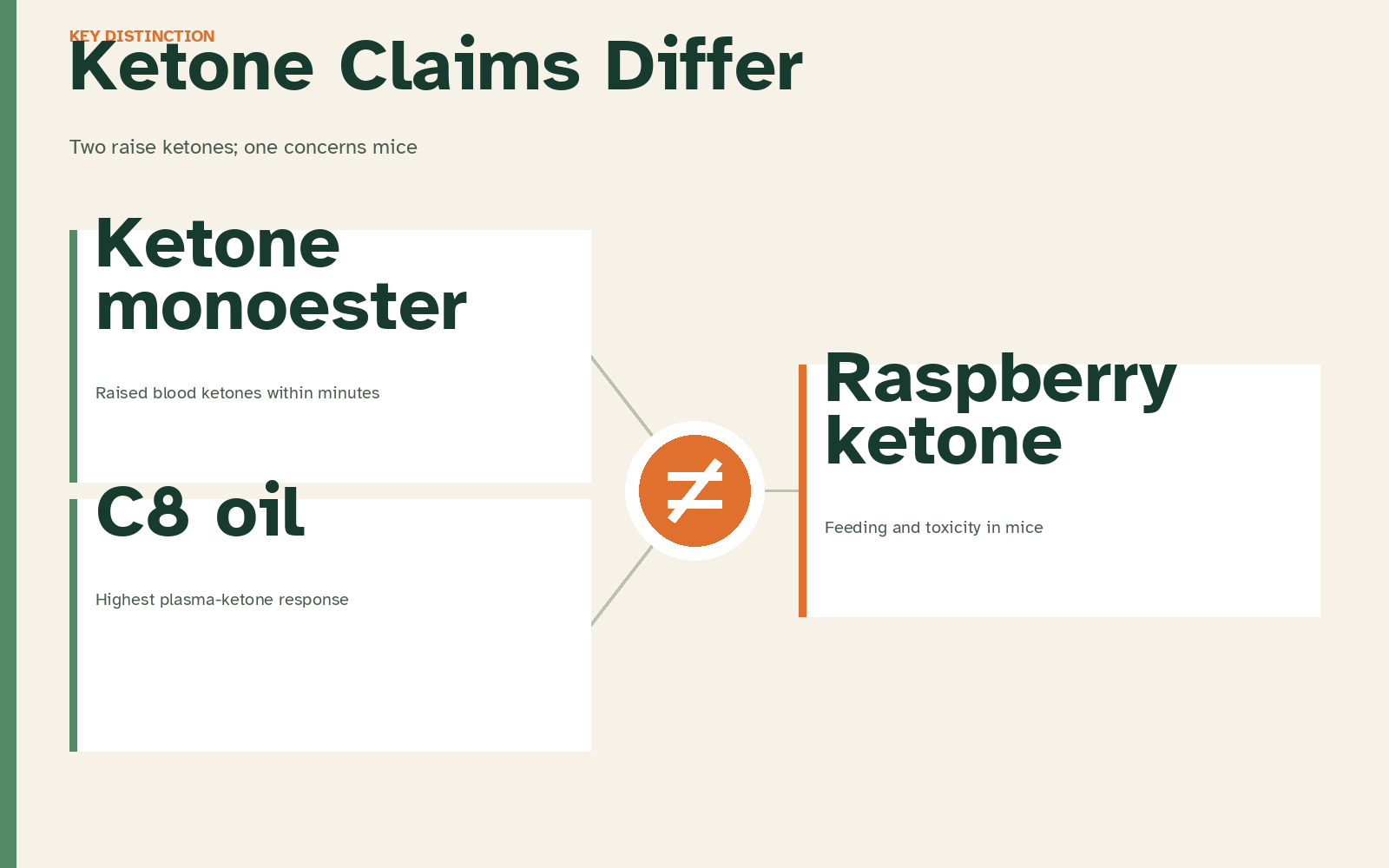
Supplements for ketosis: quick comparison of what may help and what to skip
If your goal is a practical buying decision, start here. The short version: ketone esters and some MCT products may raise ketones, while raspberry ketone is a skip based on the evidence here. None of the supplied studies showed that these products safely create sustained dietary ketosis or produce weight loss on their own.
A temporary ketone rise is not the same as established dietary ketosis. That distinction keeps you from over-crediting a supplement that changes a blood number for a few hours but does not show the broader effect most readers actually want.
| Product | What was measured | Practical takeaway |
|---|---|---|
| Ketone monoester | Blood beta-hydroxybutyrate rose within minutes | Can raise ketones directly, but not proven for sustained dietary ketosis |
| C8 oil | Largest plasma-ketone response over eight hours | More ketogenic than coconut oil in this acute test |
| Coconut oil | Much smaller ketone peak than C8 | Not interchangeable with purified C8 |
| Raspberry ketone | Mouse feeding and toxicity study, not ketosis | Name does not equal a human ketosis benefit |
Fast filter
What helps most is matching the marketing claim to the exact product studied. A ketone ester, a purified C8 oil, coconut oil, and raspberry ketone are not interchangeable just because the labels all sound ketosis-related.
Raising blood ketones is not the same as establishing dietary ketosis
This is the key comparison mistake to avoid with supplements for ketosis. A product can raise beta-hydroxybutyrate without proving sustained dietary ketosis; for practical context, compare that difference with a Keto Calculator.
The ketone ester study showed a direct biochemical effect. The MCT comparison showed an eight-hour ketone response. Neither study established faster entry into sustained dietary ketosis, so the marketing leap from “raises ketones” to “gets you into ketosis faster” is bigger than the data supports.
That matters if you are comparing supplements with basic diet changes. If you want context on how long it takes to get into ketosis, the bigger drivers are still the eating pattern and time, not just whether a product briefly moves a ketone reading.
What these products cannot establish
Do not assume a short-term rise in ketones means faster entry into sustained dietary ketosis. The MCT comparison measured an eight-hour biochemical response, while research on ketone esters, MCT products, and raspberry ketone does not establish weight loss or safe acceleration into sustained dietary ketosis.
How to evaluate a ketosis supplement claim
- Identify the product
Separate ketone esters, specific MCT types, coconut oil, and unrelated compounds such as raspberry ketone.
- Identify the measured outcome
Check whether the study measured a temporary blood-ketone response, sustained dietary ketosis, body composition, or safety markers.
- Check the study population
Distinguish evidence from healthy adults from findings reported only in animals.
- Check duration and scale
Treat short-term biochemical findings and limited healthy-adult research as insufficient proof of long-term outcomes, weight loss, or safely accelerated sustained dietary ketosis.
- Make the comparison
Match conclusions to the product and outcome studied; these products have not been shown to cause weight loss or safely speed sustained dietary ketosis.
Ketone esters: a direct but limited biochemical effect
Ketone esters have the clearest direct effect in this set of studies. In the healthy-adult research, a ketone monoester drink raised blood beta-hydroxybutyrate within minutes and kept it elevated for several hours.
That sounds impressive, but the limits matter just as much. In the 28-day study, 24 healthy adults consumed the ketone monoester three times daily, with no change in body weight or body composition. The study did not establish faster sustained dietary ketosis or weight loss.
What this actually lets you say
- It can raise blood ketones directly.
- The study followed healthy adults during repeated daily ketone monoester use.
- It did not show weight or body-composition changes.
So if a ketone ester product promises fat loss, faster keto adaptation, or a shortcut past diet changes, that promise is extending beyond what was measured here. If you track ketones, see How to Test for Ketosis for ways to interpret measurements more carefully.
MCT oil and coconut oil: compare the type, not just the label
MCT products are often marketed as if they all work the same way. The acute crossover study suggests otherwise. In nine healthy adults, C8 oil produced a larger plasma-ketone response over eight hours than coconut oil, C10 oil, or the tested C8-C10 mixtures.
| Oil tested | Study finding | What it means |
|---|---|---|
| C8 | Largest ketone response over eight hours | Most ketogenic in this comparison |
| C10 | Smaller response than C8 | Not equivalent to C8 |
| C8-C10 mixtures | Below C8 alone | Blend matters |
| Coconut oil | Peak about one-quarter of C8 | Far weaker than purified C8 here |
For shopping decisions, compare the type, not just the front-label term MCT. Coconut oil is not the same as a high-C8 product, and a mixed MCT oil is not automatically the same as purified C8.
Just keep the study boundary in view. This was an eight-hour biochemical test, not proof that any of these oils get you into sustained dietary ketosis faster. It shows a short-term difference between products, not a complete keto strategy.
Sources: [2]
Raspberry ketone: a name that does not establish a ketosis benefit
Raspberry ketone is where naming can mislead you. The name sounds relevant, but the evidence does not. The supplied study was about feeding suppression and toxicity in mice, not ketosis in humans.
That alone is enough to separate it from actual ketosis supplements. A product does not become useful for ketosis just because the word ketone appears on the label.
Start by separating the product’s marketing identity from the question you actually need answered. Raspberry ketone is a flavoring compound sold in supplement form, but the cited experiment examined reduced feeding and toxicity in mice. Because it did not investigate human ketosis, its findings cannot demonstrate that the product helps a person enter that state.
Why this is a skip
In the mouse study, a high oral dose was associated with about 43% mortality and with pathological and blood-count changes. The same study also found that doses reliably suppressing food intake were associated with pathological changes.
For a reader trying to get into ketosis faster, this evidence does not support buying raspberry ketone. It does not show a human ketosis benefit, and the supplied findings point in a more concerning direction.
The study’s safety findings deserve clear weight when interpreting the marketing. A high oral dose in mice was linked to substantial mortality, along with pathological and blood-count changes. Those observations do not establish what would happen in humans, but they do mean this experiment cannot reasonably be presented as positive support for using the compound to pursue ketosis.
Food-intake effects should not be mistaken for evidence of entering ketosis. In this mouse research, doses that reliably suppressed food intake were also associated with pathological changes. For a buyer, the practical distinction is simple: the study addressed feeding and harm signals in animals, not whether raspberry ketone produces ketosis in people.
Sources: [3]
Safety findings and their boundaries
One safety signal here is clear: in healthy adults taking a ketone monoester three times daily over a study period, measured fasting electrolytes, blood gases, and kidney function stayed unchanged. Mild nausea did occur, but only after a small share of drinks. That makes the finding specific to that product, population, and timeframe.
A separate safety result points in a different direction. In mice, a high oral dose of raspberry ketone was linked to substantial mortality along with pathological and blood-count changes. Read that as a finding from a high-dose mouse setting, not as something interchangeable with the healthy-adult ketone monoester trial or with products.
If you are scanning labels, the useful takeaway is to keep each safety note attached to the exact study behind it. One result comes from healthy adults using a ketone monoester over a short period, while the other comes from mice given a high oral dose of raspberry ketone.
Keep the safety context attached
Safety summaries must stay within study boundaries. Repeated ketone monoester use in healthy adults did not alter measured fasting electrolytes, blood gases, or kidney function, and nausea was mild. In mice, a high raspberry ketone dose caused substantial mortality with pathological and blood-count changes.
What the studies actually reported
- The ketone monoester study found normal fasting electrolytes, blood gases, and kidney function in healthy adults.
- Mild nausea was reported after 6 of 2,016 ketone monoester drinks.
- The raspberry ketone study reported serious harmful findings in mice at a high oral dose.
Those details matter if you are weighing convenience against downside. A product can be tolerable in one small healthy-adult study and still fail to show the broader benefit you want. If your concern is hydration or adaptation symptoms, What Is Keto Flu may be more useful than chasing a ketone booster.
It is also a reminder not to use general supplement categories as if they were interchangeable. If you are reviewing basics, Best Multivitamin for Keto is a separate question from whether a ketone-raising product is worth buying at all.
Evidence-limit checklist before buying a ketosis supplement
Before you trust a claim, check the product, the outcome, the population, and how long the study lasted. This one habit will screen out a lot of supplement marketing without forcing you to read every paper in detail.
Use this checklist
- Does the study show temporary ketone elevation or sustained dietary ketosis?
- Did it show weight or body-composition change, or not?
- Was the evidence in humans, or only in animals?
- Was the tested product purified C8, a blend, coconut oil, or something else?
- Does the ad promise more than the measured outcome?
Evidence-limit reminder
Match the exact product to the exact outcome. A ketone ester that raises blood beta-hydroxybutyrate, a C8 oil that outperforms coconut oil over eight hours, and a mouse raspberry-ketone study answer different questions and should not be blended into one sales claim.
How to evaluate a ketosis supplement claim: decide whether you want a temporary ketone bump, evidence of sustained dietary ketosis, or proof of body-composition change. If the study did not measure your real goal, the product may not answer your problem.
Bottom line
Most supplements for ketosis are not shortcuts to the metabolic effects of a ketogenic diet. Ketone esters can raise blood beta-hydroxybutyrate quickly, and specific MCT products such as C8 can raise ketones more than coconut oil in a short test, but neither finding proves faster entry into sustained dietary ketosis or weight loss.
If you are comparing products, the practical move is to match the claim to the exact product and outcome studied. When the evidence is animal-only, temporary, or unrelated to dietary ketosis, skipping the purchase is usually the clearer decision.
FAQs
Do supplements to get into ketosis faster actually work?
Some can raise blood ketones for a few hours, but that is not proof that they help you enter or maintain dietary ketosis faster. The supplied studies did not show sustained dietary ketosis or weight-loss effects from these products.
Which ketosis supplements may be worth comparing first?
Ketone esters and specific MCT products are the main categories with relevant human data here. Ketone esters directly raised beta-hydroxybutyrate, and C8 produced a stronger short-term ketone response than coconut oil in the acute comparison study.
Is there one supplement to get into ketosis faster than the rest?
Not from the evidence here. Ketone esters raised blood ketones quickly, and C8 outperformed other tested oils over eight hours, but neither study established faster entry into sustained dietary ketosis.
References
- Safety and tolerability of sustained exogenous ketosis using ketone monoester drinks for 28 days in healthy adults. — Soto-Mota A, Vansant H, Evans RD, Clarke K.; 2019-10-23; Regulatory toxicology and pharmacology : RTP; PMID 31655093.
- Tricaprylin Alone Increases Plasma Ketone Response More Than Coconut Oil or Other Medium-Chain Triglycerides: An Acute Crossover Study in Healthy Adults. — Vandenberghe C, St-Pierre V, Pierotti T, Fortier M, Castellano CA, Cunnane SC.; 2017-03-22; Current developments in nutrition; PMID 29955698.
- Acute feeding suppression and toxicity of raspberry ketone [4-(4-hydroxyphenyl)-2-butanone] in mice. — Hao L, Kshatriya D, Li X, Badrinath A, Szmacinski Z, Goedken MJ, Polunas M, Bello NT.; 2020-06-19; Food and chemical toxicology : an international journal published for the British Industrial Biological Research Association; PMID 32565406.
- Keto Calculator — wordpress.
- How to Test for Ketosis: Blood, Breath, and Urine Explained — wordpress.
- Best Multivitamin for Keto: Do You Actually Need One? — wordpress.
- How Long Does It Take to Get Into Ketosis? — wordpress.
- What Is Keto Flu and How Can You Reduce It? — wordpress.


Leave a Reply