
This article is written for educational purposes and paired with our editorial policy, nutrition review policy, and affiliate disclosure where relevant.
keto fermented foods can fit a carb plan, but the finished label matters more than the category name or any promise about cultures.
Health and safety notice: This article provides general education, not personal medical advice. Probiotic safety depends on intended use, consumer vulnerability, and the specific live microbe, while studies designed specifically to assess safety remain scarce. Clinical trials have not consistently reported probiotic safety outcomes, and one review concluded that the literature could not answer intervention-safety questions with confidence. Do not use this article to diagnose, treat, or make medication decisions.
keto fermented foods can fit a carb budget, but the useful shortcut is the package in your hand, not the word fermented. The finished label tells you serving size, carbohydrate, ingredients, and sometimes culture language. It does not prove lower carbs, a probiotic effect, better gut health, personal tolerance, or a keto outcome.
That distinction matters because fermented foods range from vegetables and cultured dairy to soy foods and drinks. Some may fit your plan and some may not. The practical way to sort them is to define fermented and probiotic correctly, read the finished product label, and keep the evidence limits visible.
Sources: [1] [2] [4] [5] [6] [7] [8] [9]
The quick answer: choose the finished label, not the category name
For keto, a fermented food fits only when the exact finished product works within the carb limit you chose. That means the answer lives on the label, not in the category name. A jar of sauerkraut, a cup of yogurt, a tub of kimchi, and a bottle of kombucha can all look like one category while giving you different buying answers.
The useful boundary
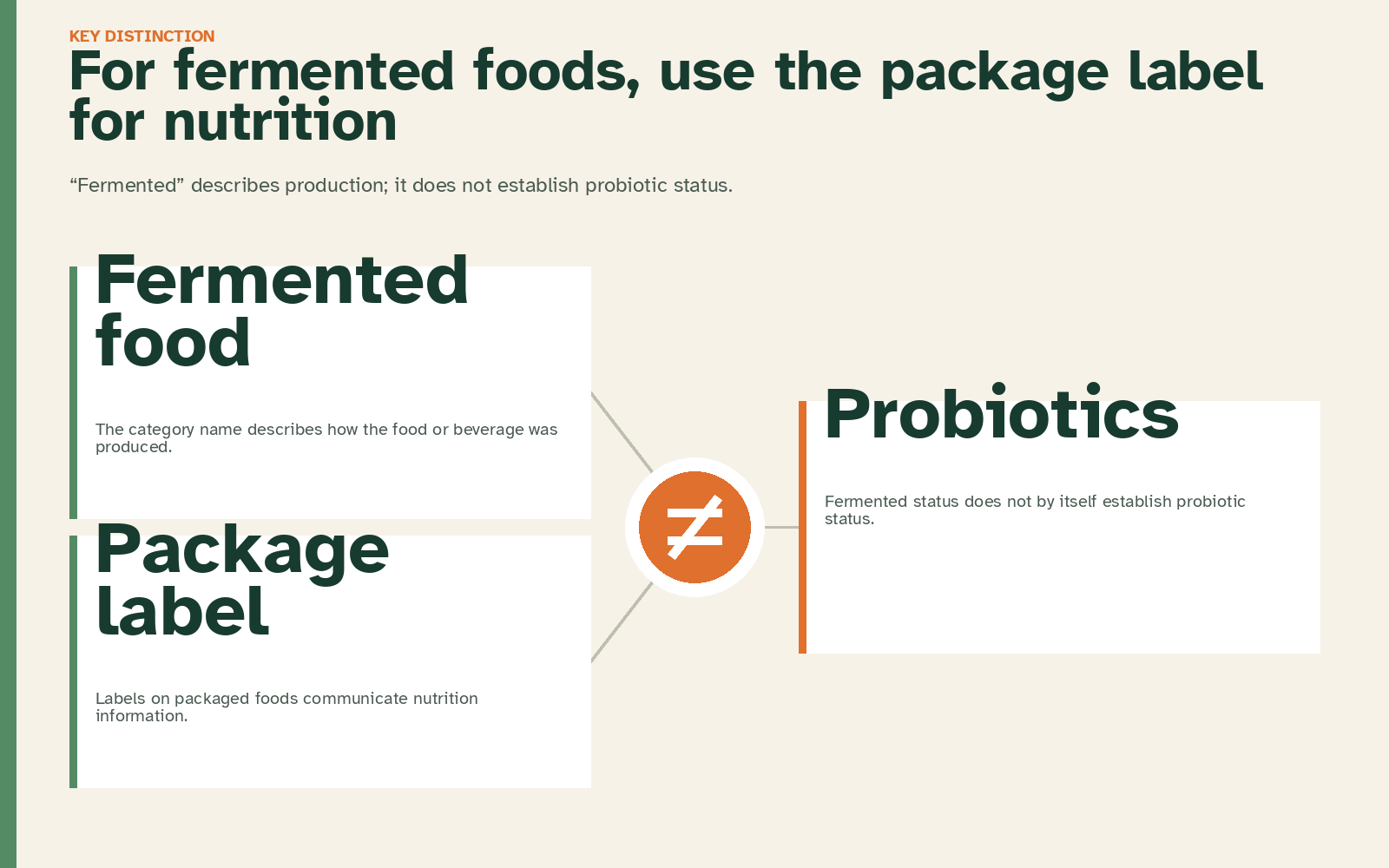
Choose fermented foods by the finished label, not by the category name. Fermented describes how a food was made; it does not certify lower carbs, probiotic status, personal tolerance, or keto fit.
The consensus definition says fermented foods and beverages are made through desired microbial growth and enzymatic conversion of food components. The same consensus also separates fermented foods from probiotics. So the first job is not to assume benefits. The first job is to confirm what the finished product says about serving size, carbohydrate, ingredients, and any culture claim.
Sources: [1] [2] [4] [7] [8] [9]
What fermented and probiotic actually mean
Fermented is a process word. It tells you that microbes and enzymes were used in the making of the food or drink. Probiotic is a different label category, so a food can be fermented without giving you a reason to treat it as probiotic.
| Term | What it tells you | What it does not tell you |
|---|---|---|
| Fermented food | Made through desired microbial growth and enzymatic conversion | Not automatic proof of low carbs, live cultures, or keto fit |
| Probiotic language | Signals a separate probiotic claim or positioning | Not a rule that every fermented food qualifies |
| Finished label | Shows the product, serving, ingredients, and carb line you can verify | Not a promise of gut benefits or ketosis |
This distinction matters in both directions. A cultured dairy food, vegetable ferment, soy food, or drink can carry the fermented label and still need a label check before it fits keto. A probiotic-sounding message still does not answer whether the product’s finished carbohydrate fits your plan.
It also keeps the research in bounds. Evidence about fermented foods generally does not become product proof for the tub, jar, carton, or bottle in front of you.
Sources: [1] [2] [3] [4] [7] [8] [9]
A package-first keto fermented foods check
Start with the exact product and serving size, because recipes and formulations vary inside the same category. If you need a broader daily carb target before you compare labels, the Keto Calculator can help set that number. After that, return to the finished package in front of you.
Three package fields to look up
- Match the exact product and flavor to its Nutrition Facts and ingredient statement.
- Compare the labeled carbohydrate with the labeled serving and the amount you plan to use.
- Read culture or probiotic language separately; fermented status alone does not establish it.
Use the finished product’s labeled carbohydrate instead of guessing what fermentation changed. Questions from shoppers often start with the process, but your keto decision depends on the food as packaged or served, not on a theory about what fermentation might have reduced.
Keep three questions separate: the product’s labeled carbohydrate, its culture language, and any expected gut or ketosis outcome.
- Carbohydrate question
Use the exact finished product’s labeled serving and carbohydrate to answer the narrow keto-fit question.
- Culture-language question
Read any culture or probiotic wording on the package; fermented status alone does not establish probiotic status.
- Outcome question
Keep gut effects, personal tolerance, probiotic safety, and ketosis outcomes separate from the package carbohydrate check.
Sources: [1] [2] [4] [5] [6] [7] [8] [9]
How fermented foods on keto can differ on the shelf
Vegetable ferments, cultured dairy, soy foods, and fermented drinks can share shelf space while behaving very differently on the label. The keto grocery list and keto fruits and vegetables guide can frame the wider shop, but each fermented item still needs its own package check. The shelf groups them together; the label details pull them apart.
| Category | Label checks | Why the name is not enough |
|---|---|---|
| Vegetable ferments | Serving, added sugar, starches | Plain and sweetened versions can differ |
| Cultured dairy | Serving, milk sugars, flavorings | Fermented does not equal probiotic or low carb |
| Soy ferments | Serving, sauces, sweeteners | Recipe style changes the finished product |
| Fermented drinks | Serving, carbohydrate, sweeteners | Finished labels can differ from bottle to bottle |
A practical kombucha keto check starts with the exact bottle, not the category name. The review reported no randomized controlled trials of kombucha, miso, kimchi, or tempeh for gastrointestinal health at the time of its search, so the name alone does not bring a proven gut claim with it.
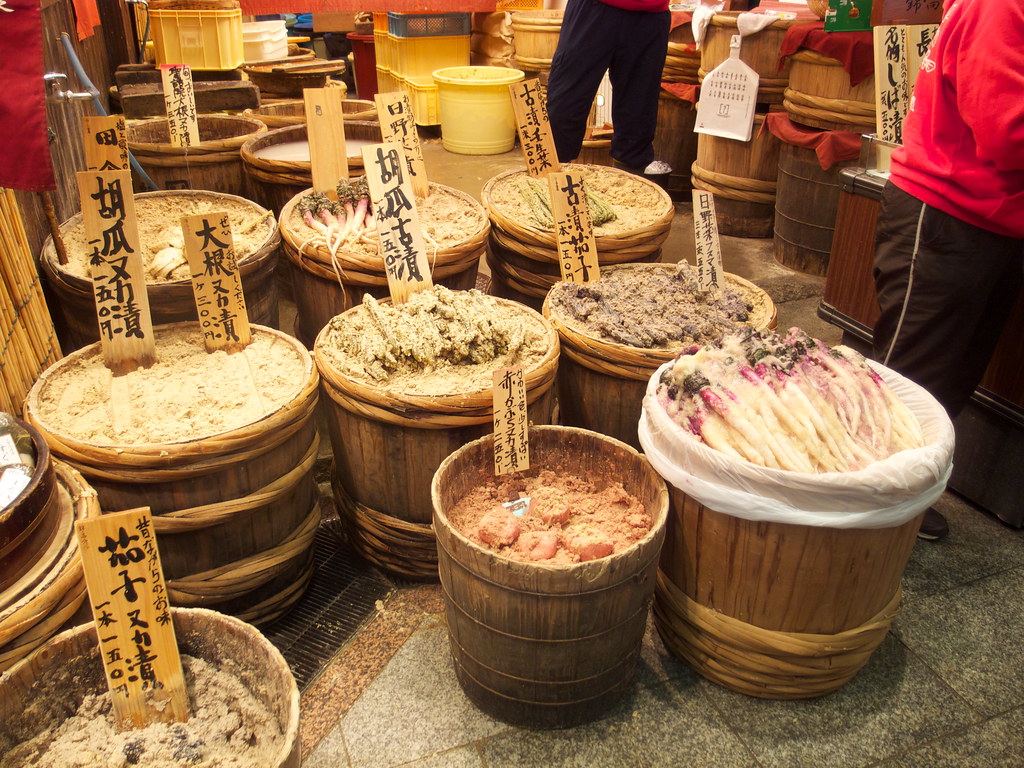
A market display can show how varied fermented foods look, but it cannot answer a package-level question. Only the specific product can show its carbohydrate line, ingredient list, and any language about live microorganisms.
Sources: [1] [2] [3] [4] [7] [9]
What the gut research supports—and what it does not
The strongest positive signal is not a keto study. A 17-week randomized prospective trial assigned 18 healthy adults to a high-fermented-food diet and 18 to a high-fiber diet. In the high-fermented-food group, microbiota diversity increased and inflammatory markers decreased over time.
Evidence limit
That result does not show what fermented foods do on keto. The fermented-food trial did not test a ketogenic diet, and the separate keto microbiome study did not test fermented-food intake.
The broader gastrointestinal review was much more cautious. It said clinical evidence for the effectiveness of most fermented foods in gastrointestinal health and disease was very limited. It also reported no randomized controlled trials of kombucha, miso, kimchi, or tempeh for gastrointestinal health at the time of its search.
The keto microbiome study still matters because it found that an eight-week ketogenic diet altered gut microbial community structure and function in a pattern distinct from a high-fat diet. What it cannot do is prove that adding fermented foods improves ketosis or creates better keto outcomes. Those are different questions.
Tolerance and probiotic safety boundaries
Tolerance can vary, and carb fit does not answer a probiotic-safety question. A food can fit a carb budget without proving how you will tolerate it. The probiotic safety literature was described as too inconsistently reported to answer intervention-safety questions with confidence.
Boundaries worth keeping separate
- Carb fit is not the same as digestive tolerance.
- Fermented is not the same as probiotic.
- Probiotic safety depends on the specific microbe and the person.
Scope boundary
Visible changes raise a separate question that a keto label check cannot answer. This article does not determine whether a product or home ferment is safe from appearance.
Probiotic safety depends on intended use, consumer vulnerability, and the specific live microbe, while studies designed specifically to assess safety remain scarce. A general culture claim cannot settle that question for every person or product.
Bottom line: choose by label and purpose
If your question is whether a fermented food can fit keto, answer that narrow question first: the exact product, serving size, and labeled carbohydrate. If your real question is probiotics, gut benefits, probiotic safety, or ketosis outcomes, ask that separately, because the same label will not answer all four.
The simplest rule
A fermented label can help you find a category to inspect, but it cannot replace the finished package or extend the research beyond what it tested.
Category names do not answer the buying decision; the finished label does. Use that rule for kimchi, sauerkraut, yogurt, tempeh, miso, and kombucha alike, then leave room for the evidence to stay limited where it is limited.
Before checkout, name the decision you are making: carb fit, culture language, personal tolerance, or an expected health outcome. Answer only the question the available information can support. That prevents a culture claim from replacing nutrition information or a low carb number from becoming a health promise.
Sources: [1] [2] [3] [4] [6] [7] [8] [9]
Bottom line
Some keto fermented foods can fit your carb plan, but the category name cannot decide that for you. Check the exact product and the amount you plan to use. Treat probiotic language, digestive effects, and keto outcomes as separate questions, because none of them follows automatically from the word fermented. Use the label for the carb decision and the evidence only for what it actually tested.
Sources: [1] [2] [3] [4] [6] [7] [8] [9]
FAQs
Which fermented foods are lowest in carbs?
There is no category-wide winner you can trust without the label. Fermented tells you how a food was made, not the finished carbohydrate value or whether it is probiotic. Compare the exact product, serving size, ingredient list, and labeled carbohydrate on the item you plan to buy.
Does fermentation reduce carbs enough for keto?
Do not assume that it does. The practical keto question is the finished product’s labeled carbohydrate for the serving you will eat or drink. Fermentation is not proof of a lower-carb result, and it does not establish a keto outcome on its own.
Are all fermented foods probiotic?
No. The fermented-food consensus explicitly separates fermented foods from probiotics, so the terms should not be treated as interchangeable. A product can be fermented and still leave you needing the label to confirm ingredients, carbohydrate, and any live-culture or probiotic language.
Is kombucha keto-friendly?
Sometimes, but the category alone cannot answer it. Check the exact bottle’s serving size, labeled carbohydrate, ingredients, and any live-culture language. A review reported no randomized controlled trials of kombucha for gastrointestinal health at the time of its search, so the name should not become a gut-benefit promise.
Can fermented foods cause bloating?
They can affect tolerance differently from person to person, and the evidence for most fermented foods in gastrointestinal health and disease was described as very limited. Keep digestive response separate from carb fit, and remember that probiotic safety depends on the specific live microbe and the person using it.
Sources: [1] [2] [3] [4] [5] [6] [7] [8] [9]
References
- The International Scientific Association for Probiotics and Prebiotics (ISAPP) consensus statement on fermented foods. — Marco ML, Sanders ME, Gänzle M, Arrieta MC, Cotter PD, De Vuyst L, Hill C, Holzapfel W, Lebeer S, Merenstein D, Reid G, Wolfe BE, Hutkins R.; 2021-01-04; Nature reviews. Gastroenterology & hepatology; PMID 33398112.
- Gut-microbiota-targeted diets modulate human immune status. — Wastyk HC, Fragiadakis GK, Perelman D, Dahan D, Merrill BD, Yu FB, Topf M, Gonzalez CG, Van Treuren W, Han S, Robinson JL, Elias JE, Sonnenburg ED, Gardner CD, Sonnenburg JL.; 2021-07-12; Cell; PMID 34256014.
- Fermented Foods: Definitions and Characteristics, Impact on the Gut Microbiota and Effects on Gastrointestinal Health and Disease. — Dimidi E, Cox SR, Rossi M, Whelan K.; 2019-08-05; Nutrients; PMID 31387262.
- Ketogenic Diets Alter the Gut Microbiome Resulting in Decreased Intestinal Th17 Cells. — Ang QY, Alexander M, Newman JC, Tian Y, Cai J, Upadhyay V, Turnbaugh JA, Verdin E, Hall KD, Leibel RL, Ravussin E, Rosenbaum M, Patterson AD, Turnbaugh PJ.; 2020-05-20; Cell; PMID 32437658.
- Risk and safety of probiotics. — Doron S, Snydman DR.; 2015-05-01; Clinical infectious diseases : an official publication of the Infectious Diseases Society of America; PMID 25922398.
- Safety assessment of probiotics for human use. — Sanders ME, Akkermans LM, Haller D, Hammerman C, Heimbach J, Hörmannsperger G, Huys G, Levy DD, Levy DD, Lutgendorff F, Mack D, Phothirath P, Solano-Aguilar G, Vaughan E.; 2010-03-04; Gut microbes; PMID 21327023.
- The effects of nutrition knowledge on food label use. A review of the literature. — Miller LM, Cassady DL.; 2015-05-27; Appetite; PMID 26025086.
- US Consumers’ Understanding of Nutrition Labels in 2013: The Importance of Health Literacy. — Persoskie A, Hennessy E, Nelson WL.; 2017-09-28; Preventing chronic disease; PMID 28957033.
- How Online Grocery Stores Support Consumer Nutrition Information Needs. — Olzenak K, French S, Sherwood N, Redden JP, Harnack L.; 2020-10-01; Journal of nutrition education and behavior; PMID 33039023.
- Carb, fat and protein changes in vegetable fermentation, specifically a ballpark reduction arc in carbohydrates by Buffalo Rabor — CC BY-SA 4.0, Stack Exchange.
- Does tea play a significant role in kombucha fermentation? by schimmch — CC BY-SA 4.0, Stack Exchange.
- Homemade yogurt by Lisa — CC BY-SA 4.0, Stack Exchange.
- Is my sauerkraut fermenting safely? by Clare — CC BY-SA 4.0, Stack Exchange.
- Is it ok to eat kimchi that is causing its package to expand? by Xophmeister — CC BY-SA 4.0, Stack Exchange.
- Slime in Fermented Pickle brine by cad — CC BY-SA 4.0, Stack Exchange.
- Fermented foods in Niishi Market, Kyoto — Andie712b, BY-SA 2.0. Made with Openverse; not endorsed by Openverse.
- Keto Calculator — wordpress.


Leave a Reply