
This article is written for educational purposes and paired with our editorial policy, nutrition review policy, and affiliate disclosure where relevant.
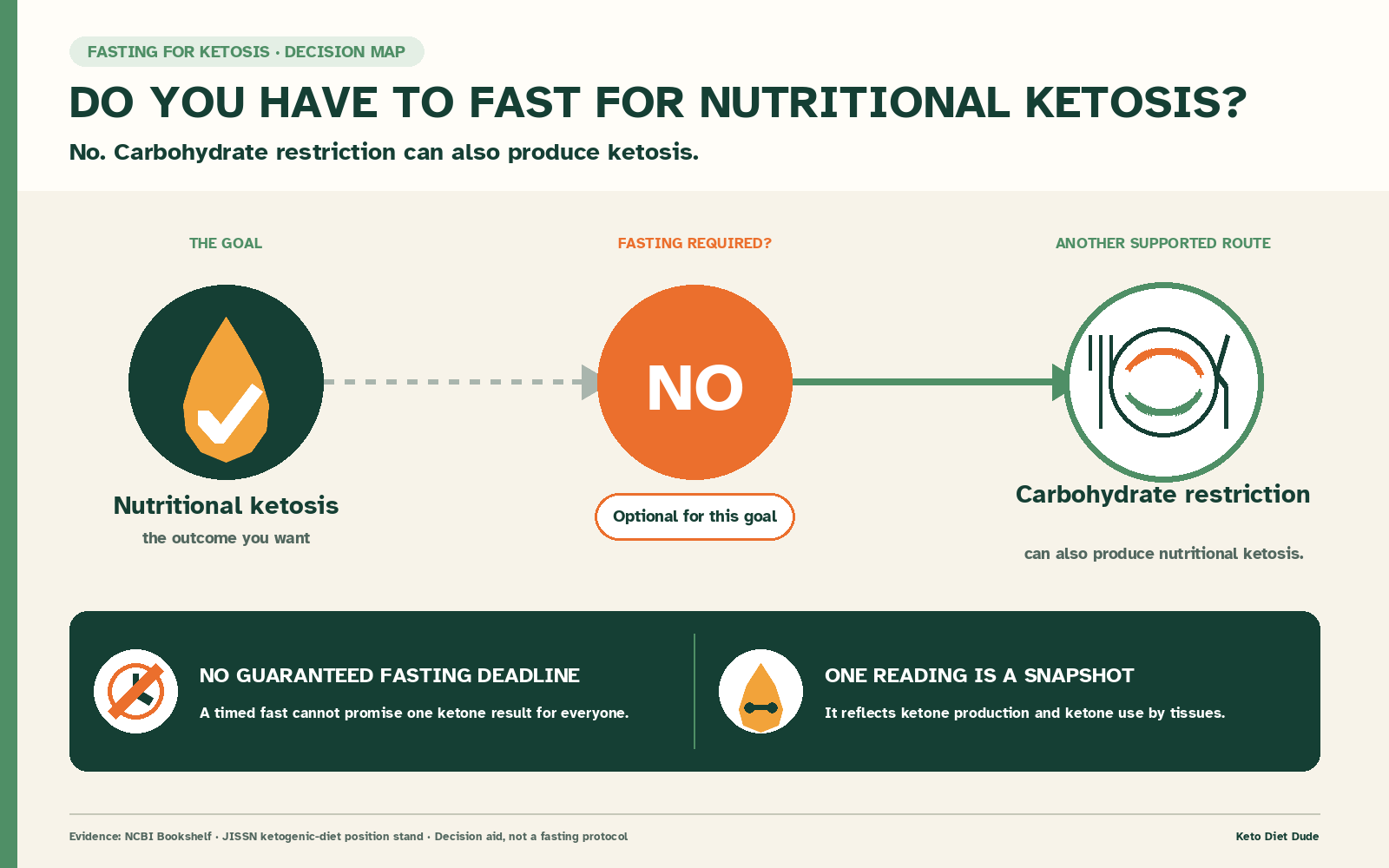
For readers considering fasting for ketosis, human evidence shows that fasting can support ketone production while carbohydrate restriction can induce nutritional ketosis without adding a fasting schedule.
Health and safety notice: This article provides general education, not personal medical advice. For people with diabetes, evidence on intermittent fasting is very limited, and any attempt should involve qualified clinical supervision and appropriate personal glucose monitoring. People with diabetes should consult their physician before beginning intermittent fasting so their medication regimen can receive appropriate oversight. Do not use this article to diagnose, treat, or make medication decisions.
Fasting for ketosis is optional. Human evidence has induced ketosis through fasting and ketogenic-diet feeding, and a position stand says carbohydrate restriction can induce nutritional ketosis. Start with the outcome you want, then decide whether changing meal timing adds anything useful.
The two approaches change different parts of eating. Fasting creates recurring periods with no or few calories. A ketogenic approach uses carbohydrate restriction. They can lead to the same metabolic state without being the same eating pattern or serving the same goal.
The practical questions are narrower: what changes in fuel use, what the research can say about timing, and how fasting strategies compare with continuous restriction for body weight. Those answers let you judge the general case without inventing a schedule.
Quick answer: fasting for ketosis is optional
Start by separating two levers. Meal timing changes when energy arrives. Carbohydrate restriction changes what the food pattern supplies. Both can sit inside a ketosis plan, but they are not the same action and do not answer the same practical question. This prevents a timing choice from masquerading as a food requirement and keeps the first decision small.
Use that distinction to change one variable at a time. If food composition is the main lever, plan that first. If timing has a separate purpose, name it before adding a fasting rule. This makes it easier to see which choice belongs to which goal. You can then assess that change before layering another structure on top.
A simpler plan is easier to evaluate. Choose the minimum change that addresses the goal, then use the relevant section below for timing, body-weight comparisons, or safety. Extra rules do not create stronger support or make a plan more personal. A timing question belongs with timing information; body weight belongs with the comparison table; diabetes belongs with clinical care.
What fasting changes in fuel use
Intermittent fasting is not one schedule. It is an umbrella term for recurring eating patterns that include periods with no or few calories. The shared feature is a change in when energy arrives; the length and arrangement of those periods can differ. Two people using the same label may therefore be describing different routines.
As liver glycogen is depleted, fatty acids are mobilized and ketones are produced from fat-derived fuel. In plain terms, the body draws down stored carbohydrate in the liver, makes more fat available, and the liver turns some of that fat-derived fuel into ketones.
That description explains a change in fuel supply, not a special property of one named fasting schedule. It also does not mean the label alone proves that every step has happened. A category of eating patterns and a metabolic shift are related, but they are not interchangeable. Use the label as a starting description, then check the specific outcome you care about. One describes the eating pattern; the other describes the body’s fuel response.
Why there is no guaranteed clock
A biological sequence is not a personal stopwatch. The reviews describe glycogen depletion before greater fatty-acid use and ketone production, but they do not establish one fasting duration that guarantees a particular ketone reading for every person.
The ketogenic-diet position stand points to the same limit from another direction: many factors affect the daily carbohydrate intake associated with its definition of nutritional ketosis. Variation in that food-based route provides no basis for converting a broad metabolic description into an exact fasting deadline.
What the research supports
Expect an order—stored liver carbohydrate falls, fatty acids become more available, and ketone production follows—but not a guaranteed hour or reading. Treat any fixed-time promise as more precise than the research allows.
For a broader overview of the factors involved, see how long ketosis takes. That resource covers the timing question in its own context; this section establishes why the broad fuel shift cannot set a pass-fail hour for every reader.
Keep the keto plan separate from the fasting decision
A ketogenic diet and intermittent fasting change different inputs. The diet uses carbohydrate restriction to induce nutritional ketosis. Fasting creates recurring periods with no or few calories. Knowing which input you mean makes it easier to change one thing at a time and judge whether that change serves the intended goal.
If you are choosing an overall structure, the keto or intermittent fasting comparison can help you examine differences beyond ketosis itself. Here, the key distinction is simpler: the food pattern can establish the ketogenic route, while meal timing remains a separate feature of the plan.
The Keto Calculator belongs to food planning, not fasting. Use it to organize the ketogenic route, with the understanding that an estimate about food intake cannot predict when a ketone reading will appear. A calculator result and a metabolic timeline answer different questions.
Intermittent fasting versus continuous restriction
For body weight, a 2025 systematic review and network meta-analysis identified 99 randomized clinical trials. It compared intermittent-fasting strategies, continuous energy restriction, and ad-libitum eating. The result depends on which pair is being compared, so the table names each pair directly.
| Comparison | Body-weight result | What it means |
|---|---|---|
| All intermittent-fasting strategies and continuous restriction versus ad-libitum eating | Each reduced body weight. | Each approach beat unrestricted eating; this was not a direct win over the other structured approaches. |
| Alternate-day fasting versus continuous restriction | Alternate-day fasting showed a body-weight benefit. | This was the sole fasting advantage against continuous restriction. |
| Alternate-day fasting versus time-restricted eating | The reduction was described as trivial. | It does not support a meaningful practical edge over time-restricted eating. |
| Alternate-day fasting versus whole-day fasting | The reduction was described as trivial. | It does not support a meaningful practical edge over whole-day fasting. |
No strategy won every body-weight comparison. Alternate-day fasting had a benefit over continuous restriction, while its differences from time-restricted eating and whole-day fasting were described as trivial. The practical conclusion is narrower than a ranking of all fasting methods.
A separate literature review leaves another question open: more research is needed to distinguish effects of intermittent fasting from effects of weight loss. If another outcome changes alongside body weight, this evidence cannot show that meal timing alone caused the change.
The diabetes safety boundary
Diabetes changes this from a food-timing preference into a clinical decision. The health and safety notice above sets out the need for qualified supervision, appropriate personal glucose monitoring, physician consultation, and medication oversight. Those safeguards come before convenience or body-weight comparisons.
The evidence on intermittent fasting for people with diabetes is very limited. A population-level finding cannot determine what will happen when one person changes periods of eating. The relevant details include current medications and the monitoring available during fasting, which is why clinical supervision is necessary.
Before beginning intermittent fasting, take the question to the physician who oversees your diabetes care. The clinical plan can then account for glucose monitoring and medication management rather than relying on a general article. The decision needs current information about your care, not an average from a trial network. Ketosis itself does not remove that need.
Decide in order: goal, route, evidence, safety
Turn the research into five concrete checks. First name the outcome, then identify the route that can address it. For body weight, note the exact comparator. For diabetes, pause before action and follow the health and safety notice.
Decision checklist
- Write down one primary outcome before choosing an eating structure.
- Use the timing guide for timing, the calculator for food planning, and the comparison table for body weight.
- If diabetes applies, pause before changing meal timing and involve the physician managing your care.
Should fasting be part of the ketosis plan?
- What outcome are you choosing?
If ketosis is the goal, compare fasting and ketogenic eating as supported routes. If the goal is body weight or meal structure, use the research for that outcome.
- Does the choice depend on an exact hour?
If yes, remove that condition because the broad fuel shift cannot guarantee a personal reading. If no, continue with the route comparison.
- Is body weight the main outcome?
If yes, use the table’s exact pairs and leave the separate weight-loss question open. If no, do not use a body-weight result to choose.
- Does the diabetes notice apply?
If yes, stop the general path and involve the physician overseeing diabetes care. If no, continue without treating the article as an individual forecast.
- What purpose would fasting serve?
If fasting serves no separate purpose, leave it out of the ketosis plan. If it serves another named goal, evaluate it against the research for that goal.
The branches end in a usable choice: use a supported ketosis route, compare body-weight structures only when body weight is the outcome, and involve clinical care when diabetes applies. Adding more rules does not make the plan more useful.
Bottom line
Bottom line: fasting is one route to ketosis, not a requirement. A ketogenic diet can also induce nutritional ketosis. The fuel shift does not promise an exact hour, and the body-weight evidence does not identify one eating structure that works best for everyone.
Choose the route that matches your goal and judge weight findings by the actual comparison. If diabetes is part of the decision, stop at the health and safety notice and take the choice to your physician before changing your eating pattern.
FAQs
Intermittent fasting ketosis?
Intermittent fasting is an umbrella term for recurring eating patterns with periods of no or few calories. It does not name one standard schedule, calorie amount, or guaranteed metabolic result. Use the term to describe meal timing, then check the specific outcome separately.
Fasting and ketosis?
Fasting can contribute to ketosis as liver glycogen is depleted, fatty acids are mobilized, and ketones are produced from fat-derived fuel. That sequence explains the connection between fasting and ketosis. It describes an order of change rather than a universal timetable.
Keto diet and fasting?
A ketogenic diet uses carbohydrate restriction to induce nutritional ketosis. Intermittent fasting changes when calories are withheld. They can be combined, but they are not a package: ketogenic eating can provide the ketosis route, so fasting needs a separate purpose if you add it.
Fasting on keto?
Being on keto does not change the diabetes safety requirements. If you have diabetes, consult your physician before beginning intermittent fasting so glucose monitoring and medication oversight can be planned for your situation. Follow the health and safety notice above rather than assuming that a ketogenic diet settles the fasting decision.


Leave a Reply