
This article is written for educational purposes and paired with our editorial policy, nutrition review policy, and affiliate disclosure where relevant.
These low carb high potassium foods provide documented options for comparing potassium, total carbohydrate, fiber, and realistic serving weights without assuming universal keto suitability.
Health and safety notice: This article provides general education, not personal medical advice. Potassium disorders are common in kidney disease, particularly with tubular disorders and low glomerular filtration rate. Evidence is limited on whether dietary modification restores abnormal serum potassium to the normal range in people with kidney disease. In a 48-week trial of patients with diabetes, hypertension, albuminuria, and diabetic nephropathy receiving lisinopril 80 mg daily, serum potassium was significantly higher when either spironolactone 25 mg daily or losartan 100 mg daily was added. Do not use this article to diagnose, treat, or make medication decisions.
These low carb high potassium foods give you three practical places to begin: raw avocado, broccoli, and spinach. To compare them fairly, start with the food form and portion you actually plan to eat, then check potassium, total carbohydrate, and fiber as separate fields.
The records below describe food composition, not a universal keto rule or a method for changing a blood test. Your carbohydrate limit remains a separate personal constraint. If kidney health affects your potassium balance, the food table alone cannot answer the clinical question.
What “low carb high potassium foods” means here
Potassium-rich does not automatically mean keto-compatible. In this comparison, “low carb” is not a universal classification. It means you can inspect total carbohydrate and fiber beside potassium, then compare your intended portion with the carbohydrate limit you have chosen.
Fruits and vegetables differ substantially in energy and nutrient composition, while also supplying fiber, vitamins, minerals, and phytochemicals. That variation is why a general list of keto fruits and vegetables cannot replace food-specific values and portion information.
Keep the nutrient fields separate
The cited USDA records report total carbohydrate and dietary fiber separately. They do not provide a calculated net-carbohydrate figure, so any net calculation would be an additional step rather than a value directly reported by those records.
Use the figures as comparison points, not as proof that a food fits every ketogenic plan. The useful decision is narrower: identify the exact food, confirm its weight, and read the documented nutrient fields before deciding how it relates to your own limit.
Compare avocado, broccoli, and spinach per 100 grams
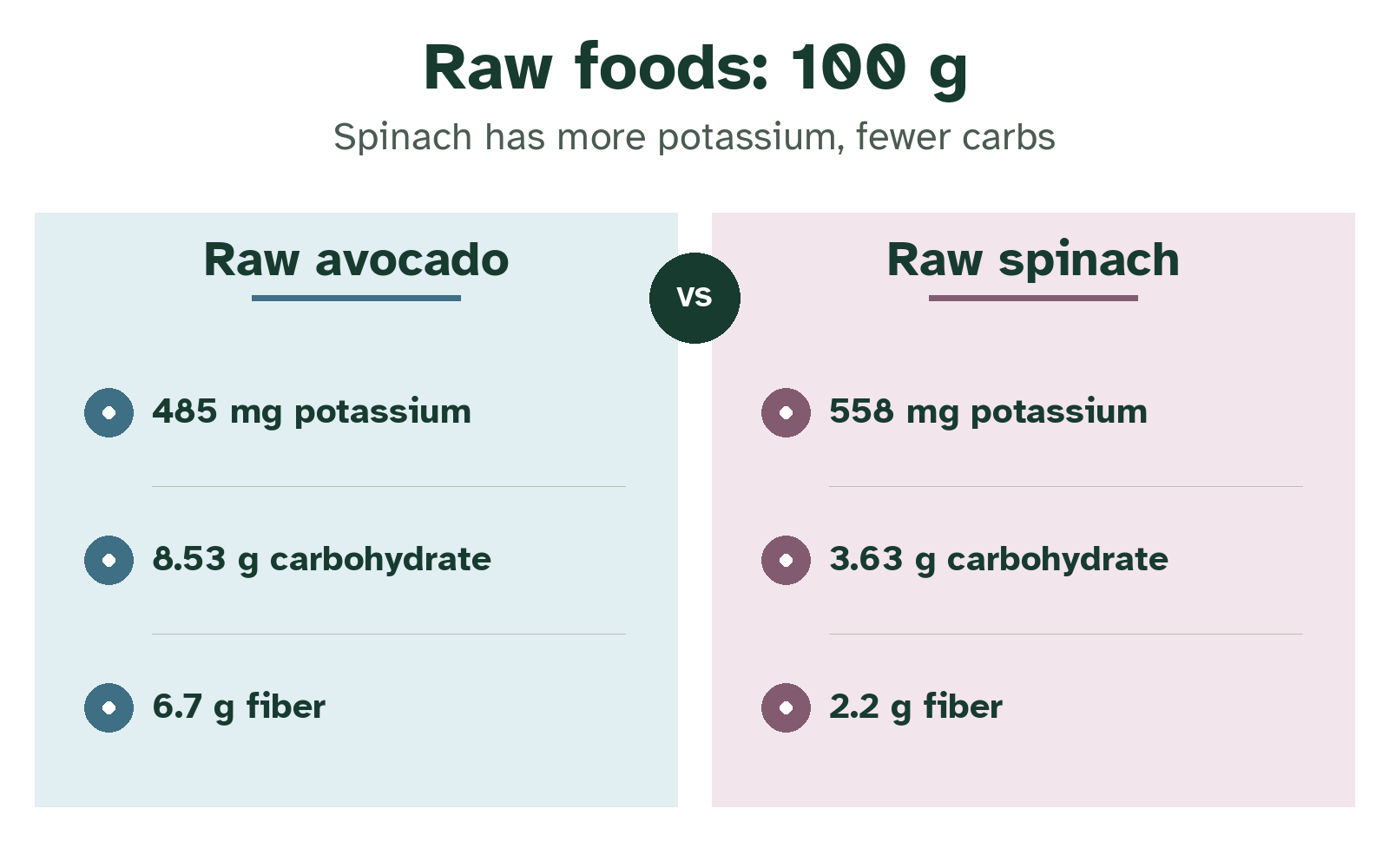
Use the 100 g figures to make a like-for-like comparison. On that basis, raw spinach has the most potassium and the least total carbohydrate of these three records. Raw avocado has more potassium than raw broccoli, but it also has more total carbohydrate and fiber.
If a potassium keto search leads you to these foods, preserve all three shown fields rather than copying potassium alone. A compact shortlist of keto potassium foods can place avocado, broccoli, and spinach in separate rows, with potassium, total carbohydrate, and dietary fiber in adjacent columns. That layout keeps each USDA record intact when you compare options.
| Food | Potassium | Total carbohydrate | Dietary fiber |
|---|---|---|---|
| Avocado | 485 mg | 8.53 g | 6.7 g |
| Broccoli | 316 mg | 6.64 g | 2.6 g |
| Spinach | 558 mg | 3.63 g | 2.2 g |
Compare potassium, total carbohydrate, and fiber on the same 100 g basis before judging a food. This controls for weight during the initial comparison, but it does not describe how much you will normally put on a plate or add to a recipe.
Make the first comparison consistent
Compare the same food form and weight before choosing a potassium source. These figures apply to the cited raw-food records, so do not transfer them automatically to cooked vegetables, packaged products, prepared dishes, or a different avocado entry.
Translate the comparison into listed serving sizes
Listed household portions vary by food and measure. The avocado record gives 50 g for an NLEA serving and 150 g for a cup of cubes. Broccoli lists 44 g per half cup chopped or diced and 91 g per cup chopped, while spinach lists 30 g per cup raw.
| Raw food | Listed portion | Portion weight |
|---|---|---|
| Avocado | NLEA serving | 50 g |
| Avocado | Cup of cubes | 150 g |
| Broccoli | Half cup chopped or diced | 44 g |
| Broccoli | Cup chopped | 91 g |
| Spinach | Cup | 30 g |
Before using a listed portion
- Match your food to the same raw form named by the record.
- Use the listed weight or weigh the amount you intend to eat.
- Keep total carbohydrate and fiber separate unless you calculate another value yourself.
Portion weight is the bridge between the table and your plate. A cup is not a consistent weight across these foods, and even avocado has several portions in its record. Use the gram weight attached to the exact description instead of treating every cup or serving as interchangeable.
A label-first process for fitting these foods into keto
Match the planned food form and portion to your chosen carbohydrate limit instead of relying on a keto label. The aim is not to certify a food as universally compatible. It is to make the food record, portion, and personal limit visible as separate parts of the decision.
A Food-First Potassium Comparison Process
- Choose the food form
Match the item to the cited raw-food record rather than assuming another form has identical values.
- Check the serving weight
Use a listed portion weight or weigh the planned amount before applying values reported per 100 g.
- Compare nutrients
Review potassium, total carbohydrate, and dietary fiber separately because the records do not calculate net carbohydrate.
- Check the keto fit
Compare the planned portion with your chosen carbohydrate limit without treating the food as automatically keto-compatible.
- Keep clinical boundaries separate
Do not extend kidney-disease or narrowly defined trial findings beyond the populations and outcomes actually studied.
The records do not calculate net carbohydrate. If you track a different carbohydrate measure, make clear that it is your calculation rather than a directly reported USDA field. You can use the Keto Calculator to review broader diet targets, but it does not turn a food-composition entry into personal medical guidance.
After choosing a portion, compare its applicable carbohydrate information with the limit you use. That comparison can organize a meal-planning decision, but the cited food records do not validate your limit, prove that the portion fits, or show how changing the meal will affect ketosis.
Safety boundaries supported by the cited evidence
Food values are not a personal safety assessment
Potassium disorders are common in kidney disease, particularly with tubular disorders and low glomerular filtration rate. Glomerular filtration rate describes how well the kidneys filter blood. A food list cannot determine whether increasing potassium is appropriate in that setting.
Boundaries to keep visible
- Consult a qualified healthcare professional when kidney function or tubular disorders may affect potassium balance.
- Over 48 weeks, lisinopril 80 mg-treated patients with diabetes, hypertension, albuminuria, and diabetic nephropathy had higher serum potassium with spironolactone 25 mg or losartan 100 mg.
- See the evidence-limits discussion for what remains unknown about dietary modification and serum potassium.
For the practical comparison, return to the table: it places raw avocado, broccoli, and spinach on the same basis, making their documented potassium, total carbohydrate, and dietary fiber values directly comparable.
Evidence limits and unanswered questions
Use USDA entries to answer composition questions only: they document nutrients and listed portions for specific raw foods. Questions about ketogenic diets, meal plans, or blood-test outcomes require clinical evidence rather than food-record data.
What the evidence cannot establish
Evidence is limited on whether dietary modification restores abnormal serum potassium to the normal range in people with kidney disease. That uncertainty prevents this food comparison from becoming a corrective diet protocol or a promise about a laboratory result.
Questions these records leave open
- They do not report a calculated net-carbohydrate value.
- They do not make medication-associated serum potassium findings evidence for a dietary strategy.
- They do not extend a narrow clinical trial result to other populations or regimens.
USDA records document total carbohydrate and dietary fiber as separate fields without calculated net carbohydrate; the kidney-disease review instead provides clinical context on potassium disorders and evidence limits.
Sources: [1] [2] [3] [4] [5] [6]
Practical food-comparison checklist
Before choosing among these foods, check the food form, portion weight, and separate nutrient fields. This prevents a raw-food value, a household measure, and a personal carbohydrate limit from being blended into one unsupported claim about whether a food is “good for keto.”
After making a provisional selection, perform a transcription audit. Place the food name at the top of your note, then copy potassium, total carbohydrate, and dietary fiber into separately labeled lines. Because the cited records keep carbohydrate and fiber separate, this layout makes an accidental substitution or merged value easier to notice before the note is reused.
Use a second pass to compare labels across your notes rather than comparing unlabeled figures. Avocado, broccoli, and spinach each have their own documented potassium, total carbohydrate, and dietary fiber values. Keeping the nutrient names attached to the food name helps reveal when a value has been copied from the wrong row or assigned to the wrong field.
Use this check in order
- Confirm that the food matches the cited raw avocado, broccoli, or spinach record.
- Find the exact listed weight or weigh the portion you plan to use.
- Read potassium, total carbohydrate, and dietary fiber as separate values.
- Treat any net-carbohydrate figure as a calculation, not a reported field here.
- See the dedicated safety section for kidney-related and serum-potassium considerations.
What these checks can and cannot tell you
Document the exact USDA raw-food entry, household portion description, and corresponding gram weight selected so the comparison remains traceable to the intended food record.
If two foods both appear workable, compare the portions you would genuinely eat rather than selecting solely from the 100 g ranking. Avocado, broccoli, and spinach can all contribute potassium, but their documented carbohydrate, fiber, and listed serving weights differ.
Bottom line
Avocado, broccoli, and spinach can each contribute potassium, but they differ in carbohydrate, fiber, food form, and serving weight. Compare the exact portion you plan to eat rather than relying on a broad keto label.
Food records can support that comparison, but they cannot show that a diet will correct an abnormal serum potassium result. Kidney disease changes the safety context, so personal clinical questions belong with a qualified healthcare professional.
FAQs
How can I get potassium on keto?
Compare potassium-containing foods using the same food form and weight, then evaluate your planned portion against the carbohydrate limit you follow. The cited raw-food records document avocado, broccoli, and spinach, but they do not determine whether a serving is suitable for every ketogenic diet.
Which foods are high in potassium and low in carbs?
Among the three raw foods compared here, spinach has 558 mg potassium and 3.63 g total carbohydrate per 100 g. Avocado has 485 mg and 8.53 g, while broccoli has 316 mg and 6.64 g. Portion size still matters.
What potassium sources can I compare for keto?
Raw avocado, broccoli, and spinach are three documented options in this comparison. Check the exact form, serving weight, potassium, total carbohydrate, and fiber separately. Do not assume cooked, packaged, or differently prepared versions have the same values as the cited raw-food records.
Which low-carb foods are high in potassium and magnesium?
This comparison cannot identify the best magnesium choices because it compares potassium, total carbohydrate, fiber, and serving information only. Use a record or label that shows magnesium directly rather than assuming that a potassium-containing food also supplies a particular amount of magnesium.
References
- USDA FoodData Central: Avocados, raw, all commercial varieties (FDC 171705) — first party.
- USDA FoodData Central: Broccoli, raw (FDC 170379) — first party.
- USDA FoodData Central: Spinach, raw (FDC 168462) — first party.
- Health benefits of fruits and vegetables. — Slavin JL, Lloyd B.; 2012-07-01; Advances in nutrition (Bethesda, Md.); PMID 22797986.
- Potassium homeostasis and management of dyskalemia in kidney diseases: conclusions from a Kidney Disease: Improving Global Outcomes (KDIGO) Controversies Conference. — Clase CM, Carrero JJ, Ellison DH, Grams ME, Hemmelgarn BR, Jardine MJ, Kovesdy CP, Kline GA, Lindner G, Obrador GT, Palmer BF, Cheung M, Wheeler DC, Winkelmayer WC, Pecoits-Filho R, Conference Participants.; 2019-10-10; Kidney international; PMID 31706619.
- Addition of angiotensin receptor blockade or mineralocorticoid antagonism to maximal angiotensin-converting enzyme inhibition in diabetic nephropathy. — Mehdi UF, Adams-Huet B, Raskin P, Vega GL, Toto RD.; 2009-11-19; Journal of the American Society of Nephrology : JASN; PMID 19926893.
- Keto Fruits and Vegetables: Low-Carb Choices That Fit — wordpress.
- Keto Calculator — wordpress.
- Supplements for Ketosis: What May Help and What to Skip — wordpress.


Leave a Reply